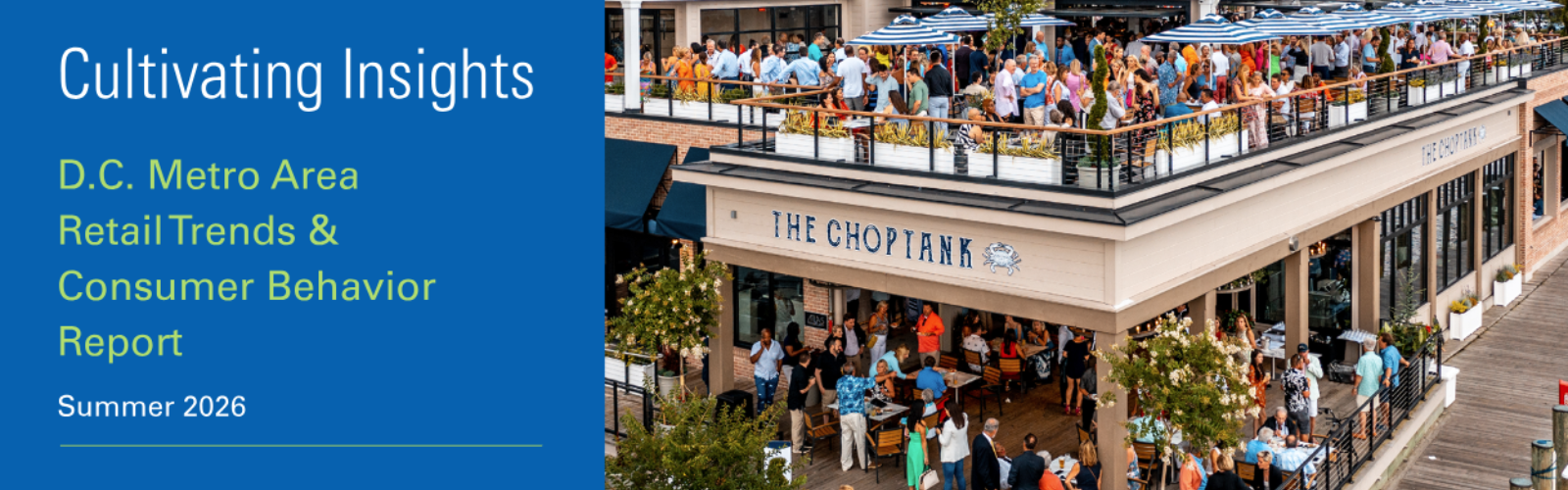
Retail has always changed alongside consumer behavior, but today’s shifts feel different. They’re less about one dominant trend and more about the choices people are making every day. Shoppers are weighing price against convenience, deciding which experiences are worth spending on, and becoming more selective about where they devote both their time and money. Those decisions are reshaping retail across the D.C. Metro area.
That’s what inspired Rappaport’s Summer 2026 Cultivating Insights report.
Drawing on retail visitation data and consumer behavior across the D.C. Metro area, the report explores how shopping habits continue to evolve and what those changes could mean. For retailers evaluating expansion opportunities, landlords planning tenant strategies, and investors assessing market demand, understanding these behavioral shifts can help inform better market decisions.
Rather than focusing only on where people are shopping, the report looks at why they’re making those choices in the first place.
One theme appears throughout the research: today’s consumers are becoming more intentional. Value still matters, but value doesn’t always mean finding the lowest price. Sometimes it’s convenience. Sometimes it’s quality. Other times it’s an experience that justifies spending a little more. Understanding those tradeoffs is becoming just as important as understanding traditional market trends.
Sebastien Aubouin, Rappaport’s Director of Research & Systems Development, points to this balancing act as one of today’s defining consumer characteristics, “People are hunting for bargains at wholesale clubs, splurging on memorable dining experiences, spending less time browsing physical stores, and balancing everyday necessities with selective purchases that reflect their lifestyle and personal priorities.” That combination helps explain why some retail categories continue to outperform while others face new challenges.
Perhaps the biggest takeaway from the report is that change doesn’t have to be viewed as something to overcome. It can also be a competitive advantage for organizations willing to question old assumptions. Consumer expectations will continue to evolve, and the businesses that pay attention to those shifts, and adjust accordingly, will be better positioned to meet future demand.
The report is also a reflection of the work behind the scenes at Rappaport. Our team spent months analyzing data, identifying patterns, and turning those findings into practical insights that clients can actually use. Their work helps move the conversation beyond headlines and broad industry trends, providing a clearer picture of what’s happening across the Washington retail market.
At Rappaport, we’ve always believed that strong real estate decisions begin with understanding the people behind the data. Cultivating Insights continues that commitment by examining the behaviors shaping today’s retail landscape and providing a framework for thinking about what’s next.
We invite you to view the full Cultivating Insights: D.C. Metro Area Retail Trends & Consumer Behavior Report to explore the trends, observations, and opportunities influencing the future of retail throughout the D.C. Metro area.